Showing posts with label Bookshelf. Show all posts

Practicing Radical Hospitality

The Congregational Practice of Radical Hospitality
Congregations that practice Radical Hospitality demonstrate an active desire to invite, welcome, receive, and care for those who are strangers so that they find a spiritual home and discover for themselves the unending richness of life in Christ. Radical describes that which is drastically different from ordinary practices, outside the normal, that which exceeds expectations and goes the second mile.
--Five Practices of Fruitful Congregations (www.fivepractices.org)
As the newly elected lay leader in my local church, I have been thinking what it is that I could do to improve the situation of the local church.

I belong to a very small local church with more or less 20 adult members and 10 kids who regularly attend Sunday worship. I have been a member of that church since I was eight, I guess. I attended children's Sunday school classes, then taught, joined outreach programs until I moved to Manila for college. Somehow, I have witnessed the ups and downs of the congregation. I have seen how the congregation struggled with leadership, finances, and properties. The old building where we used to hold our services is already replaced with a new, larger one; only it has not been completed yet.

It has been over a year now when I started regular attendance in my small local church again, having moved and married in Isabela. Now that I hold a key leadership position, I have been wondering how we could grow as individuals and as a congregation in faith and ministry.

My mom, who is the Church Council Chairperson, and I talked about how we should move on. We have been trying to assess the situation of the local church but we cannot sum up everything. Most of our observations are on the negative side--most members are not tithers/givers, they come late on Sunday, they don't want to hold leadership roles, they are not commited to the ministry, they are not exposed to the affairs of the church outside of the local church, they are not willing to attend activities other than Sunday worship, they do not participate in the Bible study, they do not read their devotional materials, etc.

On the other hand, we don't think that our local church is weak--we earnestly pay our connectional obligations, we can pay our pastor's salary and benefits, we produce leaders in the higher levels of the church, we have children's ministry, we have two outreach points.

So what could be lacking? What could be wrong?

To address what we thought are problems, I facilitated a round table discussion, though we were not literally in a round table. My aim was to enable each member to speak and share what they think about the church and its ministries. It is more than a meeting but prayerfully and reflectively considering the life of our local church and how the church is relevant to the lives of individual members and their families. Of course we did away with parliamentary procedures! And for the first time, I saw how eager each member to share their insights. I know it is a long and slow process. But I believe it will be worth whatever it is that we spend on this consultative process. The first step is to have an honest and prayerful conversation.

We started answering sort of self-examination questions like:
What makes you excited in going to church?
What makes you stay in this small local church?
What makes you sad about our local church?
What makes you tired in your spiritual life?
When did you see God work in all these?

In that moment, I knew that I was exercising radical hospitality. This kind of hospitality is not only shown to new members or visitors, but also to members--being sensitive enough to let them in into the decision-making process, know their insights, and encouraging them to be engaged in the life and ministries of the local church. I think that for a long time, I have been very comfortable in sitting in my favorite spot in the church, gave my tithes and offering, and attended regularly Sunday worships but actually did not mind about the relationships that exist in my local church.

Our conversations emphasized the importance of the established relationships inside the local church, where members feel that they are part of the family whenever they go to church on Sunday. Many are excited to come on Sundays because they love to see the kids and to bring their children to Sunday school. Many are inspired because of how the lives of other members are lived. That made me realized that maybe many are not involved in the ministries or seem to not be growing spiritually because they are being left out in our "family" as we have focused so much in planning programs, reporting, earning the building fund, and mandating people to take leadership positions. When in fact, we could have started knowing what they wanted in the first place. Begin with relationship! We need to be more hospitable with our own family members.

After the first meeting, we agreed to meet some more and continue answering self-examination questions until we have all tackled the Five Practices of Fruitful Congregation (as written by Robert Schase), until we have come up with our vision-mission-goals statement, and maybe until such time that each member will fully engage and grow in the life and ministry of the local church. It is like going back to square one. But I like it more that way rather than trying to accomplish written programs with just few people involved.

I know that this will be a difficult, and maybe painful, process but I am challenged to be more hospitable and sensitive to needs of my family members. We will be moving to more sensitive issues like giving, tithing, getting involved in missions, and taking up leadership roles. But my hope is each one will show a radical hospitality.

A Healthy Way through the Lenten Season

“What eating practices should I change?”

If there is one season when one should start changing for a healthier lifestyle, I think it should be during this Lent. Lent is a season of fasting and prayer, and fasting, I believe, should be done in consideration of the holistic renewal of a person—not only spiritually but also physically. One way or the other, the field medicine have proven that fasting has a lot of physical benefits.

Sure, there are different kinds of fasting, but for the sake of this post, I will concentrate on my personal commitment to a healthier eating habits this Lent and beyond.

See, I have given you every plant yielding seed that is upon the face of all the earth, and every tree with seed in its fruit, you shall have them for food. –Genesis 1:29

since it enters, not the heart but the stomach, and goes out into the sewer? (Thus he declared all foods clean.) –Mark 7:19

Forget about soda. I am not really a fun of soda, I drink some occasionally but even though I know that there no nutritional value in it, I still drink. This time, I want to do do away with it. Instead, drink more water and homemade fresh fruit juices.

Chips and curls, and french fries. I believe I can live without these food except for occasional cravings. Oh my French fries, it is even ranked as one of the unhealtiest food but sometimes I am still tempted to eat, I hope I can resist.

Less meat, more fish. I am trying so hard. I am not a meat lover but when I am in school, most of the menu are meat and there’s no way I can eat something different. But at home, I make sure to cook more fish, even though my husband likes pork and beef a lot. Well, he has no choice but to eat my cooking; and later on, I know both of us will be healthier.

Increase vegetable and fruit intake. Again, I have to make a lot of effort for this especially for fruits. Fruits are very expensive but I think it really needs a budget. I am just glad the some green leafy vegetables grow in our front and back yards and anytime I want to eat, I can just go outside and pick.

Look more outside, not inside the refrigerator. I need to look more in our yard for food instead of the refrigerator. Vegetables are still healthier!

On another note, I have started reading the book “Food, Fitness, and Faith for Women.” It is with high hopes that I can keep with this healthy habits within 21 days. Because a study said that if you can do things for 21 days straight, there is a great probability that you can do it in the following days. So let me try and I promise to let you know if my improvement.

Small Changes, Big Results

Today is the best day to change your life, thus the tag line of Jerry Foster‘s book, Small Changes, Big Results (2004).

Though it present itself as a self-help book, it is rather inspirational. It does not shout at your throat what you should do step-by-step to change your life but it has examples of real people and real experiences that will help the reader realize about his own circumstances in life. It presents practical principles and strategies that are easy to adopt as they enable you to be more conscious or aware of the choices that you make today.

The book is very imaginative. It lets you think your own “what ifs” and “how ifs” and lead you to rethink the things, events and choice that you made and all the possible cumulative outcome in the future. It will make you see into those small things that seemingly insignificant but can create big changes in the future. The author wants the readers not to disregard the small things but see it as a part of a holistic development of a person. Also, he encourages relationships, something that many people neglects in this very busy and fast paced world.

Since the author of the book is a businessman, there are business jargon throughout the text but nonetheless they are well explained and related to life situations; and they make the book more practical and realistic because you are assured that many of it are based from the personal experience of the author that worked over time. The book drives the readers to answer the questions, “Who am I?” and “What am I here for?” through discovering one’s potential and maximizing talents as they are intended to be.

The Vector Principle
Foster used the vector principle in his presentation of the choices that a person makes in his/her life. The principle states that each choice you make vectors you (direct, change angle) to a certain destination. “You are currently on a course that was determined by choices you made since you were aware of your capacity to choose. Many of these choice seemed rather insignificant at the time, but small changes make a big difference over time.”

It does not matter whether you are in your twenties, forties or sixties as long as you are conscious of your choices and decisions, you can still change for a fruitful and well-lived life. A person can choose to invest  his/her life toward the path of indifference, path of indulgence, or path of influence. The path of indulgence is the self-centered life. The path of indifference, on the other hand, is existence-centered life. Finally, the part of influence is an others-centered life.

Foster leads the readers to take the path of influence which is characterized by the transformation of other people, personal satisfaction seeing others benefit, and broader perspective in life. This is the path that is grounded on relationships and vision. It strengthens the claim of John Wooden that “Real happiness and success comes from things that cannot be taken from you.” Those things are the legacy that a person can leave after his/her life of earth. Those things are the relationships that are build in love, and visions realized in confidence that bring out the best of life.

Five lifeWealth
Foster coined the term lifeWealth to describe the full investment that a person can make in his/her. It is “The accumulation of financial, relational, physical, intellectual and spiritual capital. (Here goes the business lingo!)

The author encourages each person to invest into the five lifeWealth. These can be treated like a bank where a person can deposit every choices or results that come after, good or bad, for future usage. The profitability of these investments depend on how a person manages them to comply to the vision he/she has in mind or want to accomplish for the future for his/her own life.

This lifeWealth principle leads the reader to evaluating each aspect and plotting vision that are realistic and can gain profit over time. The author has provided strategies how to evaluate and plan toward attaining the fullness of life. Though the book discusses so much of the future, it does not neglect the “now”, in fact it has given it importance because the “now” determines the future. And in the end, the person shall enjoy contentment.

I found this book in the shelf of Christian/Inspirational. The author has quoted some Biblical foundations and personalities to explain his points but even though, I still think that his principles apply whether you are a Christian or not—because all person come into a point in life when they become aware of their choices and have the ability to choose.
Author: Jerry Foster with Ed Stewart
Year Published: 2004
Publisher: Fleming H. Revell

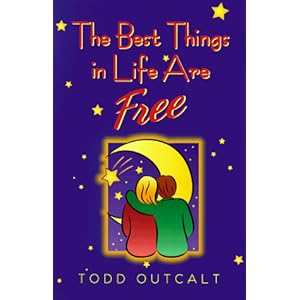
The Best Things in Life are Free

Many of us do not realize that the best things in life are actually free. It is because we are confined in a very materialistic world and we measure the best things in terms of price, weight, karat, size, model, etc. In this book, however, Todd Outcalt reminded me of the things that I have but not really aware of them—those things that make me happy—people, faith, love, hope, work and experiences. It is not actually the material things that define a person. He wrote, “the best things often happen to us when we are not aware of them.” True enough, as I flipped through the pages, it made the realize that I have taken some things for granted.

I got the book from a book table display, it was the author’s gift to Jeff and Arlene (whoever they are). And because they received it for free, they gave it away for free. Have you ever tried “free taste”? Product manufacturers and promoters let prospective customers taste their products for free to let people know that theirs are the best. And “free taste” really are best compared to the same products found on the shelves.

This book made me more conscious of the things I see and feel and more aware of my environment. It made me notice the the simple things and pleasures that may remain unnoticeable when I am always busy or rushing. For example, a street kid smiling at me brightens up the day.

The book is divided into five parts where Outcalt pours his experiences and the lessons he learned in his entire life. This is sort of an autobiographical account of the author but it is also his biographical account for the people he encountered that taught him the best things in life. Though the narratives came from the stories of his childhood and adulthood, his lenses are very sharp to capture the moments. He used very elaborate words of description as if wanting the readers to experience the same in their own eyes.
The book is "about the small gifts of life." After careful assessment, Outcult stated the following conclusions:
  • We value family and friends and children more than things.
  • We all want to love and be loved.
  • We'd rather laugh than cry.
  • An actual sunset is more awesome than a picture of sunset.
  • We all want to achieve something in life.
  • We cherish our memories more than our knowledge.
  • We desire to help others.
  • We all hope and believe in something or someone greater than ourselves.
  • Rest is more satisfying after a hard day's work.
Author: Todd Outcalt
Year of Publication: 1998
Publisher: Health Communications, Inc., Deerfield Beach, FL